





Introduction
As a startup founder or entrepreneur, you know what it feels like during rapid growth: long hours, tough decisions, and the pressure to grow without breaking the system that got you here. Hiring fast, landing new clients, and managing products. Whatever aspect you’re scaling, it becomes evident—growing means building support. And not just any support for smart, flexible, and scalable business technology solutions.
Those days when only enterprises could access a higher level of software or infrastructure are long gone. Today, there is a stack of smart tools specifically designed for startups to move quickly, remain lean, and punch well above their weight. From cloud-based platforms and automation tools to virtual support and data analytics, a good tech stack can make or break your momentum.
In this blog, I’ll take you through the top tech solutions startups are leveraging today and how these solutions can unlock your next stage of growth without adding complexity or cost.
Why Technology is Key For Rapidly Compounding Startups
Startups are founded on innovation, speed, and agility, but they usually lack resources, have small teams, and face increasing demands. That’s why proper business technology solutions are not just useful — they’re necessary. Technology is the bridge connecting a startup’s vision with execution in a scalable manner.
Relatively modern startups have to cater to a variety of roles: sales, marketing, customer care, operations, finance, and product development. With a lean team, it simply becomes next to impossible to manage all these functions without technology.

But the right tools enable startups to:
- Running on a tighter ship with fewer full-time hires while maintaining high output.
- Save time and reduce manual errors by automating repetitive tasks.
- Improve customer experience through personalized communication and responsive service.
- Use real-time data and analytics dashboards to make smarter decisions.
- Scale as needed without renovating systems every time you hit a growth spurt.
In other words, technology allows you to build repeatable, trackable systems and get your startup running like a well-oiled machine—even when you have few staff to help.
For instance, if you are a dentist, instead of remembering which patients need follow-up or how often you are posting on social media, these workflows can be automated in the background by using automation tools. CRM platforms prevent both your leads and your business development team from falling through the cracks, while project management software helps keep your team aligned around deliverables.
At the end of the day, business technology solutions help you grow, not harder. They are the secret to maintaining momentum, avoiding burnout, and giving yourself a leg up — particularly in rapidly evolving markets where speed of execution, consistency, and the ability to pivot can truly matter.
Capabilities Where Technology Enables Startup Growth
1. Project and Task Management

Tools That Keep Teams Aligned
Startups are fast, and without good systems in place, things get missed. Platforms such as Trello, Asana, ClickUp, and Notion enable teams to plan, assign, and track tasks in real-time. They also provide templates, deadline tracking, and integrations with other apps to centralize work across departments.
Impact
Project management tools enhance visibility, minimize redundant work, and keep your team focused on the tasks that matter. They create a centralized space for founders, remote teams, and freelancers to work seamlessly together while increasing productivity and reducing confusion. This kind of precise centralization is vital for fast-growing startups. It ensures that projects bring in revenue on time, team members are accountable, and nothing falls through the cracks, enabling the company to scale without chaos. By leveraging customizable workflows and real-time updates, these tools become the central nervous system that helps teams drive consistent execution and sustainable growth.
Also Read: Virtual Assistant Services in Marina East
2. Collaboration, Networking, Teamwork

Staying on the Same Page with Everyone
Internal communication needs to be frictionless, whether you’re just a 3-person team or managing contractors from all around the world. Tools such as Slack, Microsoft Teams, and Zoom enable real-time conversations, video meetings, and file sharing.
Impact
Business Technology Solutions reduce email clutter and enable startups to keep a tight feedback loop — the key to being quick in the fast-running world of startups solving problems and creating a culture of transparency and speed. More importantly, they enable team members to stay aligned no matter the location or time zone. File sharing, instant messaging, and its discussion-thread function have eliminated all back-and-forth and ensured that context is preserved. As a startup grows, effective internal communication lays the groundwork for sound decision-making and positive company culture, which are essential for long-term success.
3. Customer Relationship Management (CRM)

Following Up and Maintaining Relationships with Clients
CRMs such as HubSpot, Zoho, and Pipedrive allow you to track leads, automate outreach, and manage the entire customer journey — from first touch to post-sale follow-up.
Impact
A good CRM system makes sense of this chaos. They enable startups to close more leads, keep more clients, and customize interactions — without requiring an entire sales force. CRMs consolidate data and make sure that no customer is overlooked or forgotten. Automated features ensure that follow-ups and reminders are timely and accurate. This enhances your capacity to create long-lasting relationships, drive conversions, and consistently expand customer engagement—even more relevant when faced with a rapidly expanding list of potential customers.
4. Accounting and Finance Tools

Simplifying Money Management
Start-ups should not have messy finances. Cloud-based solutions such as QuickBooks, Xero, and Wave empower entrepreneurs to manage invoices, payroll, and cash flow from anywhere.
Impact
These financial tools minimize the strain of tracking numbers manually while improving compliance and offering a glance into your company’s financial status in real time. So, this helps startups “budget” appropriately and be “always investor ready.” Everything from projecting costs to accurately reporting taxes is simplified with well-defined finance processes, keeping your operations both audit-ready and scalable. These tools also allow integration with CRMs and bank feeds to offer an aggregated view of revenue performance, growth trends, and cost-saving opportunities, giving startups the security of making confident, data-backed decisions.
5. Automation and Workflow Optimization

Time Savings on Repeated Actions
Tools such as Zapier, Make ( Integromat), and IFTTT allow you to automate tasks between your apps, such as syncing your leads between your CRM and your email tool or triggering specific follow-ups after a form submission.
Impact
Automation opens up both your time and your mental bandwidth. For startups, it translates to lean operations, never sacrificing service or speed. It also aids in minimizing mistakes and ensures that vital tasks aren’t overlooked. But more importantly, automation structures daily workflows, making your team more consistent, predictable, and scalable. Lead nurturing, invoice reminders, email sequences — automation makes sure every step of your customer and internal processes is a streamlining triumph.
6. Marketing and Content Management

The Growth of Visibility and Engagement
Marketing tools like Canva, Buffer, Mailchimp, and WordPress allow you to create your content, schedule campaigns, and manage your website without even having a full marketing team.
Impact
You don’t need to spend a lot of money to market well. These tools help startups with brand awareness, lead nurturing, and consistency, which are all must-haves for long-term growth when competing in an aggressive market. With an easy drag-and-drop design, prebuilt templates, and automated publishing, you can punch above your weight online. Consistency in marketing means your brand is projected in satin on the runway on repeat every time an audience comes in touch with your brand, leaving no room for confusion, all without hiring an entire in-house production team.
7. Data and Analytics

Turning Numbers into Strategy
Knowing what’s working (and what isn’t) is essential. Analytics tools such as Google Analytics, Hotjar, Looker Studio, and Mixpanel provide data around user behavior, website performance, and campaign metrics.
Impact
Smarter decisions are made with data-backed information. Analytic tools allow entrepreneurs to focus on what delivers results and pivot from what doesn’t. That clarity is critical for getting every dollar and hour right. — Whether you’re tracking marketing return on investment or user behavior on your app, these tools serve up opportunities and highlight inefficiencies. They also help to back up investor presentations and team meetings with hard data, simplifying the process of prioritizing what works as a component of your growth strategy and what doesn’t.
Also Read: Virtual Assistant Services in Marina South
8. Security, Cyber, and Data Protection

Securing Your Digital Assets
Growth attracts attention and risk. Solutions such as LastPass, 1Password, Cloudflare, and encrypted cloud storage aid in locking down your startup’s data, logins, and client information.
Impact
You work with sensitive data every single day at a startup. You could lose clients and credibility after a data breach. An initial investment in cybersecurity tools lays a safer foundation for the business and demonstrates to customers and investors that you care about protecting their data. These tools safeguard anything from login credentials to shared documents, which minimizes the risk of cyberattacks, phishing, or human error. Security is more than a tech problem — it’s a brand trust problem. Strong protection upfront protects your reputation and secures business continuity.
Virtual Support: The Game Changer in Tech-Driven Expansion
This is a challenge that can become overwhelming to manage, even with the best tech tools, particularly for bootstrapped startups. Enter virtual assistants (VAs) and remote support teams to help. These professionals provide behind-the-scenes support for your operations, making it easier to adopt technology and manage growth.

1. Set up and manage your technology stack:
Startups tend to adopt a large number of tools quickly, but without proper configuration, these platforms can work against each other. Virtual assistants can take care of the technical onboarding — integrating tools like CRMs, project management apps, and scheduling software — to make sure that everything works together seamlessly. They also conduct routine maintenance, keeping platforms up-to-date and recognizing potential inefficiencies early on.
2. Serve as your CRM and email automation:
CRM must be in place and properly used to track leads and nurture prospects. VAs can enter data, clean contact lists, segment audiences, and create automated email sequences. Behind the scenes, this ongoing effort will improve conversion rates and help you solidify your relationships with clients without you needing to lift a finger.
3. Book Meetings And Force Admin:
Whether it be setting up booking calls, managing inboxes, or organizing shared files, VAs ease day-to-day operations. They remove administrative distractions, allowing you to concentrate on strategy and growth. Their backing streamlines the internal process and alleviates burnout from too many tasks.
4. Content And Marketing Asset Creation:
Want graphics for social media, blog formatting, newsletter formatting, or email campaigns? VAs with a creative background can assist with content strategy to keep your business visible and compelling across platforms and to ensure brand consistency.
It all comes down to how your performance is understood. VAs can collect data from marketing tools, sales dashboards, and website analytics and provide simple reports. Doing so keeps your decision-making rights and is quick in a significant business.
The Future of Technology in Business
As the digital world continues to advance, so do the tools that drive entrepreneurship and growth. We aim to make business technology solutions work better, smarter, integrated, real-time proven, and based on advanced personalization.
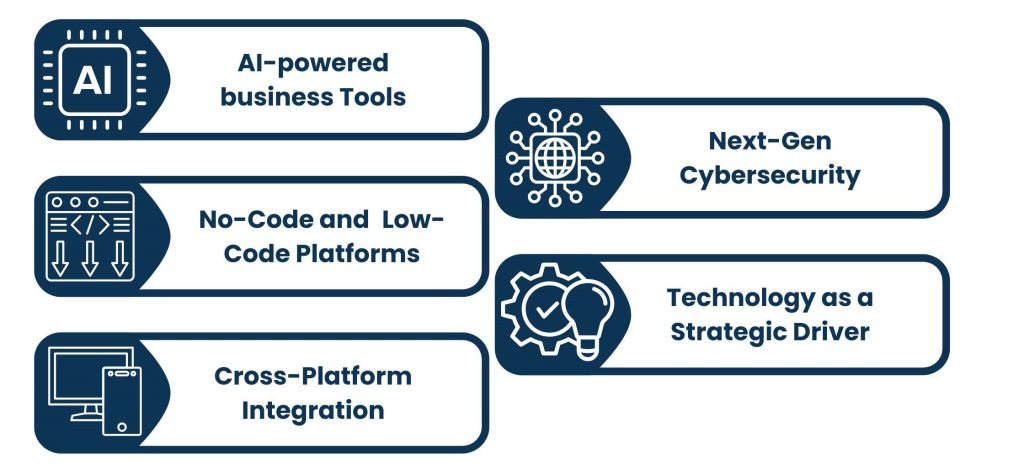
Here are the main trends driving a new wave of innovation:
1. AI-powered business Tools:
Assume clever CRMs, automated customer service bots, tailored advertising systems, and information analytics supported by artificial intelligence. These tools allow small teams to compete with large enterprises – nautomating tasks, improving customer experience , and driving data-driven intelligent decision-making.
2. No-Code and Low-Code Platforms:
You want to create apps, automate processes, and prototype products without writing a line of code. This widespread availability of platforms lowers the barriers to innovation in ways that are simple, affordable, and scalable, giving average non-technical founders the ability to execute ideas quickly and cost-effectively.
3. Cross-Platform Integration:
Future-forward startups will lean on tightly integrated systems. CRM syncing with email marketing, sales connected to support tools, and analytics linked with financial dashboards. This degree of integration enhances collaboration, reduces manual entry, and delivers frictionless user journeys.
4. Next-Gen Cybersecurity:
With more remote teams and cloud-based tools, data protection is a must-have. To keep sensitive information secure right out of the gate, startups are adopting zero-trust models, encrypted file sharing, and secure collaboration platforms.
5. Technology as a Strategic Driver:
Instead of just being a support function, tech becomes a driver for product development, marketing, and even customer experience strategies. The founders who treat technology as a strategic partner and not just a tool will build the most adaptable and future-ready startups.
Startups that seize these rising trends early on will be better poised to scale, pivot, and compete in an ever-emerging digital marketplace.
Conclusion
So, if you’re scaling a fast-growing startup or building your entrepreneurial dream, don’t get slowed down by outdated systems or disconnected tools. The right business technology solutions not only support growth, they drive it.
From automation, communication, and CRMs to cybersecurity, technology enables you to operate smarter, serve better, and scale faster. And with the backing of capable virtual support, these powerful tools enable you to function like a bigger business without the expense or hassle.
Having the biggest team or budget no longer holds to competitive edge — it’s about how effectively you leverage the resources at your disposal. A lean, tech-enabled business with the right systems and virtual support can beat out even the biggest players. Whether you’re preparing for a funding round, launching a new product, or expanding to new markets, your tech stack and remote team will be your foundation. Invest wisely, delegate strategically, and keep your focus where it belongs—on building something great.
At Tasks Expert, we help startups and entrepreneurs streamline operations with virtual support trained in today’s best business technology solutions. Let us help you build a tech-enabled team that scales as fast as you do.
About Us
Tasks Expert offers top-tier virtual assistant services from highly skilled professionals based in India. Our VAs handle a wide range of tasks, from part time personal assistant to specialized services like remote it support services, professional bookkeeping service etc. Furthermore, it helps businesses worldwide streamline operations and boost productivity.
Ready to elevate your business? Book a Call and let Tasks Expert take care of the rest.

About Author

Gary Katz
Related Blogs