





Introduction
An AI powered virtual assistant is not concerned with replacing people. It is concerned with eliminating the resistance in work. Companies are faced with duplicated efforts, sluggish follow-ups, disjointed information and overworked staff. It is costly to bring on board additional staff. It is dangerous to overlook inefficiencies. AI-based help can address this gap.
In contrast to conservative automation, AI powered virtual assistants are flexible, develop patterns, and assist workflows in an intelligent manner. They do not only work with human teams but also deal with structured tasks like scheduling, data handling, customer queries, reporting, and internal coordination.
Speed is not the only element that makes the AI powered virtual assistant worth its money. It is uniformity, scalability and less reliance on human input. Properly used AI support enables companies to expand without adding more disorder.
This blog dissects the mechanism behind the functionality of AI powered virtual assistants, their areas of greatest application, and why companies are starting to incorporate them into their operations.
What an AI Powered Virtual Assistant Actually Does in Business Operations
An AI powered virtual assistant is not just a simple piece of automation. It assists the day to day functioning of the business in the processing of routine activities, information and rules and behavior triggered actions.
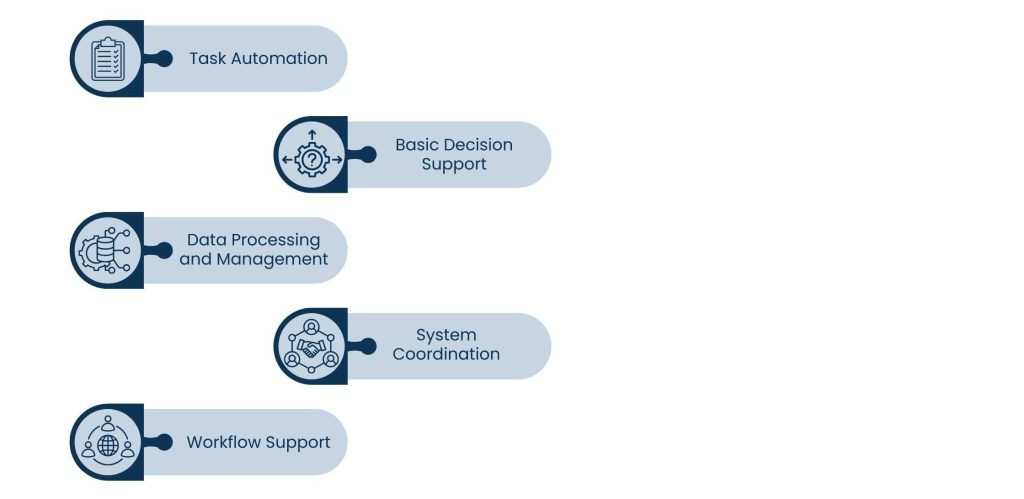
Key functional areas of responsibility encompass:
-
Task Automation:
Automates routine tasks performing things like meeting scheduling, record updates, report creation and reminders automatically.
-
Data Processing and Management:
Data is organized into processes, information is classified and records are kept in clean systems to minimize human errors.
-
Workflow Support:
It does the next steps according to pre-determined conditions to prevent delays in processes.
-
Basic Decision Support:
Refers to historical data and rules to propose actions or indicate the problems that must be addressed by humans.
-
System Coordination:
Relates various tools and platforms in such a way that information can flow throughout the departments.
As opposed to strict scripts, AI powered virtual assistants evolve according to usage and patterns. This increases their reliability in the long run. Companies enjoy a smooth running operations without being supervised.
Also Read: Media Asset Management
The reason why Businesses are moving towards AI Powered Virtual Assistants at Scale
The pressure of operations expels the need of AI powered virtual assistants. Business shall be rapid, precise and responsive without the costs swelling.

The major motivating factors that lead to adoption are:
- Operational Efficiency: AI eliminates low-value activities, allowing the teams to work on strategy and execution.
- Uniformity: There is consistency in automated operations in the sense that the same actions are being applied whether due to fatigue or carelessness of humans.
- Scalability Without Headcount Growth: The support of AI can be scaled immediately without the need to recruit, onboard, or train.
- Faster Response Times: The daily tasks and interviews are attended to instantly rather than waiting in lines.
- Cost Control: Companies eliminate the need to use manual labor when performing repeatable tasks and keep the level of output.
The first companies to utilize AI powered virtual assistants have an operating advantage. They work faster, change faster and can control even when they get more complicated.
AI Powered Virtual Assistants vs. Traditional Virtual Assistants
Virtual assistants based on AI and those based on traditional virtual assistants have different uses. Knowledge of the difference eliminates unrealistic expectations.

Difference between implementation and value:
- Speed of Execution: Human assistants are sequential in their tasks whereas AI does the same in real time.
- Scalability: The size of AI is infinite, and the size of the human is limited.
- Decision Boundaries: AI does not break rules or patterns, people deal with judgment and subtleties.
- Error Patterns: The error made by AI is foreseeable and can be corrected. Errors in man depend on work and circumstances.
- Cost Structure: The marginal support of AI decreases with volume.
AI as an alternative to human is not the most effective model. It is AI with human oversight. Companies who integrate both AI powered virtual assistants with human teams in their operations gain both speed and selectivity.
Also Read: Data Feed Management
The Best Places to Use AI Powered Virtual Assistants
Virtual assistants based on AI generate the greatest value when implemented on large-volume, rule-based processes.

The use cases of high impact are:
- Administrative Operations: Task tracking, document handling and internal coordination.
- Customer Support Triage: Resolving routine questions, routing tickets and gathering information prior to escalation.
- Sales and CRM Operations: Modifying pipelines, recording contacts and initiating follow-ups.
- Reporting and Monitoring: Production of regular reports and smoking flags.
- Process Compliance: Ensuring workflows are followed in a consistent way.
These applications help in cross-departmental friction. AI powered virtual assistants are best applied at the intersection of speed, accuracy, and repetition.
Managing Risk and Control With AI Powered Virtual Assistants
The use of AI is dangerous when unregulated. Effective implementation is centered on governance, boundaries and oversight.

Mechanisms of control that businesses need to put in place:
- Defined Task Scope: AI does not work under unclear responsibilities and therefore eliminates mistakes, overreaching, and misaligned behaviors.
- Human Approval Layers: Human validation is mandatory to critical tasks, which have to be accountable and fast and accurate.
- Data Access Limits: Only necessary information is provided to AI which lowers the risk of security breaches and offers protection to sensitive company data.
- Audit and Monitoring: Tracking and logs can give insight into AI activities, which can be used to ensure transparency and continuous control.
- Continuous Optimization: Work processes are continuously streamlined to suit the changing business requirements and performance objectives.
AI powered virtual assistants minimize risk when controlled, as opposed to creating it. Design control is not a restriction.
Conclusion
AI powered virtual assistants are not a trend. It is a change in the manner in which work is done. AI helps empower businesses to grow swiftly by automating routine functions, facilitating workflow, and enhancing consistency.
Balance is the actual advantage. AI deals with velocity and frequency. Judgment and strategy are something that humans deal with. They combine to form efficient, robust and responsive operations.
In the case of Tasks Expert, businesses embrace the usage of AI-driven virtual assistants in conjunction with the implementation of formal operational assistance to ensure that automation does not make the performance complicated but rather makes it more efficient.
AI does not replace teams. It enables them to work harder.
Frequently Asked Questions
It is a computer assistant that is operated through automation and intelligence to process routine business operations and processes.
They serve different roles. AI is fast and repetitive, humans are judgmental and make decisions.
Yes. AI enables small teams to perform effectively without the need to add to the human resources.
Rule-based, high-volume and repetitive tasks are the most valued.
Yes. Human control gives accuracy, control and adherence to business objectives.
About Us
Tasks Expert offers top-tier virtual assistant services from highly skilled professionals based in India. Our VAs handle a wide range of tasks, from part time personal assistant to specialized services like remote it support services, professional bookkeeping service etc. Furthermore, it helps businesses worldwide streamline operations and boost productivity.
Ready to elevate your business? Book a Call and let Tasks Expert take care of the rest.

About Author