
Introduction
Businesses require market research techniques in an attempt to understand customers, minimize risks, and make sound decisions. In the opening few lines, we are being clear. Firms that bypass research make their decisions through guesswork, and guesswork is costly.
Markets change fast. The expectations of the customers change. Competitors adapt. Lack of organized research means that any business will roll out products that no one desires, sell them at the wrong prices, or even at the wrong market. Market research techniques are able to create a clear picture based on data prior to making decisions.
By 2026, basic surveys will no longer be of use in research. Companies are integrating both qualitative and quantitative data and digital behavioral analysis to get a holistic picture of their market. This blog is a deconstructive approach to the most essential market research techniques, situations when they should be employed and how they can help to make better business decisions.
What Market Research Methods Actually Aim to Solve
Market research tools are not intended to gather data but to answer certain questions that are specific to the business.

They assist businesses to realize:
- Who the target customers are
- What are the issues of customers?
- The buyer decision-making process of the customers.
- What the competition is offering.
- In areas that have market opportunities.
The successful research does not allow assumptions to rule the strategy. Rather, the decisions are made depending on evidence, patterns, and actual customer behavior.
Also Read: Data Enrichment Services
Qualitative Research Methodology in the Market
The qualitative research is concerned with motivation, opinion, and behavior. It clarifies the reason why customers do what they do.

1. In-Depth Interviews
One-on-one meetings with the customer or prospect.
- Investigates points of pain and expectation.
- Helpful in product development and positioning.
- Gives profound background information.
2. Focus Groups
Presentation in small groups led by a moderator.
- Discloses common attitudes and perceptions.
- The concept testing and the feedback on the message.
- Encourages the discussion of ideas.
3. Observational Research
Researching the interaction of the user with a product or service.
- Determines usability problems.
- Reveals real-world behavior
- Eliminates the use of self-reports.
The best way to go is a qualitative approach, where the businesses require a clear vision before constructing or altering something.
Quantitative-based Market Research Methods
Quantitative research is concerned with measurable characteristics and trends. It replies to the questions of how many and how often.
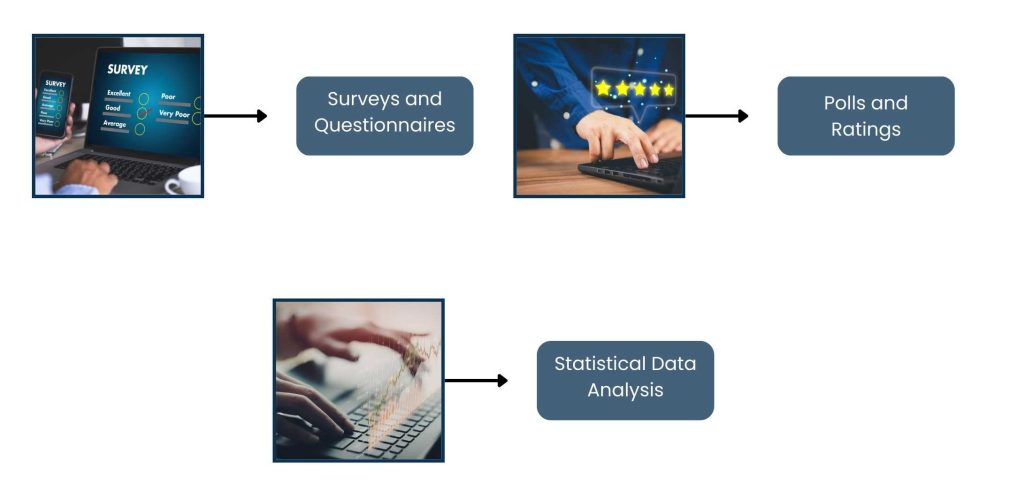
1. Surveys and Questionnaires
Questionnaires were given to a huge population.
- Asserts satisfaction and preferences.
- Favors statistical analysis.
- Scales easily across markets
2. Polls and Ratings
Rapid feedback gathering instruments.
- Useful for fast insights
- Tracks sentiment trends
- Digital audiences.
3. Statistical Data Analysis
Applying numerical data in determining trends.
- Sales performance analysis
- Market demand forecasting
- Customer segmentation
Quantitative studies in market research are essential in situations where the organization requires magnitude, confirmation, and quantifiable assurance.
Also Read: Ecommerce SEO Consultant
Primary vs Secondary Market Research
Understanding the source of data is just as important as the method.

| Research Type | Description | When to Use |
|---|---|---|
| Primary Research | Data collected directly from customers | New products, market entry, customer validation |
| Secondary Research | Existing data from reports, studies, and databases | Market sizing, competitor analysis, trend research |
Most businesses in 2026 combine both to reduce cost while maintaining accuracy.
Digital and Modern Market Research Methods
Technology has increased the mode of research.
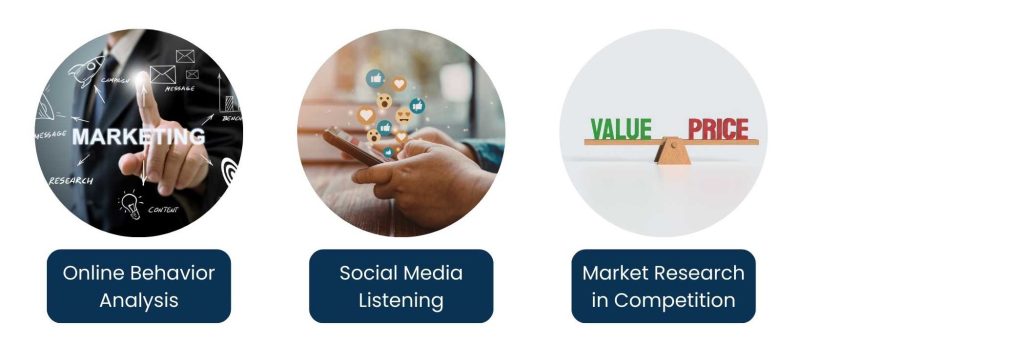
1. Online Behavior Analysis
Monitoring user behaviors on sites, advertisements and content.
- Click behavior
- Session duration
- Conversion paths
2. Social Media Listening
Towards cross-platform monitoring.
- Brand sentiment analysis
- Trend identification
- Monitoring of competitor activities.
3. Market Research in Competition
Comparing the services of competitors, pricing, and message.
- Determines market gaps.
- Atomic to differentiation strategies.
- Influences positioning decisions.
Digital techniques can offer real-time insights, which traditional research cannot deliver on its own.
Choosing the Right Market Research Methods
All the methods are not suitable for all the goals. Depending on the question asked, the selection may or may not be made.

Qualitative methods should be used in cases where:
- Learning and uncovering needs or opportunities that cannot be fulfilled
- Learning customer emotions, motivations, and decision behavior.
- Evaluation of preliminaries to later investment in development.
- Determining customer sore spots, objections, and area of friction.
- Streamlining value propositions on actual customer perceptions.
Use quantitative methods when:
- Testing assumptions using statistically reliable data.
- Determining market size, demand, and purchase intentions.
- Comparison of customer segments to prioritize targeting
- Monitoring the performance measurements and trends.
- Underpinning investment, prudent growth, or pricing decisions with data.
The majority of successful business houses use a combination of several methods of market research to see a balanced picture.
Common Mistakes Businesses Make in Market Research
Good approaches do not work well when applied in the wrong manner.

Asking the wrong questions
The case of bad questions or misleading questions gives an appearance of helpful data but presents wrong conclusions.
The use of small or biased samples.
Unrepresentative audiences give false results and a business would overestimate demand or misunderstand customer needs.
Ignoring insights after collection
Insight contained in research is only valuable when converted into strategy, action and measurement.
Treating research as a one-time task
The world of markets is dynamic and old knowledge becomes obsolete quickly.
Those companies who consider research a checkbox exercise miss the real strategic ingredient of research – and usually make similar expensive errors.
The support of market research methods to the development of business

Successful research enhances:
1. Product-market fit
Real customer needs, pain, and purchasing behavior are confirmed by research and enable companies to create products that people desire, rather than wasting resources in trial and error.
2. Marketing messaging
The customer language, motivation, and objection insights enable the brand to design messages that appeal to customers, enhance their engagement, and convert more.
3. Pricing strategies
Market research shows the willingness to pay, competitor benchmarks, and perceived value, and allows setting prices in a way that will maximize revenue and not to lose customers.
4. Customer experience design
The feedback, journey mapping, and behavior analysis assist in identifying the areas of friction that corporations can use to develop a more effective and enjoyable customer experience.
By 2026, market research will not be an option to businesses that have growth ambitions. It is an ongoing process whereby all key decisions are informed.
Conclusion
Market research approaches assist companies in substituting assumptions with wisdom. Wealth of knowledge qualitative insights with quantitative validation and digital data analysis, will help the company to have a clearer picture of their market and customers.
Companies that are most successful in market research consider market research a discipline and not a one-time activity. By making informed strategy decisions based on research, businesses mitigate risk, enhance alignment and discover opportunities ahead of their competitors. We empower businesses at Tasks Expert by enhancing both research and operational processes which can enable smart and data-driven decision-making by teams.
Frequently Asked Questions
They are methods of gathering and examining information regarding markets and customers.
It depends on the goal. Qualitative methods look at behavior whereas quantitative methods are measured in size.
Not always. Numerous online and questionnaire-based approaches are affordable.
Yes. Targeted research is of great use to small businesses.
On a continuous basis particularly in dynamic markets.
About Us
Tasks Expert offers top-tier virtual assistant services from highly skilled professionals based in India. Our VAs handle a wide range of tasks, from part time personal assistant to specialized services like remote it support services, professional bookkeeping service etc. Furthermore, it helps businesses worldwide streamline operations and boost productivity.
Ready to elevate your business? Book a Call and let Tasks Expert take care of the rest.

About Author